
By ValueData Research & Marketing Services | B2B Database Provider in India | Updated: July 2026
Every B2B marketing and sales team eventually hits the same wall: campaigns that used to work start bouncing, replying, or converting less — even though nothing about the strategy changed. In most cases, the strategy isn’t the problem. The data is. This is where data cleansing comes in. In this blog, we explain what data cleansing actually means, why B2B contact data breaks down faster than most teams realize, and how a structured cleansing process protects your revenue, your sender reputation, and your team’s time.
Data cleansing (also called data cleaning or data scrubbing) is the process of identifying and correcting — or removing — inaccurate, incomplete, duplicate, or outdated records in a database. For a B2B Contact Database, this typically means fixing or removing:
Data cleansing is not a one-time project. Because contact data changes constantly — people switch jobs, companies merge, phone numbers get reassigned — cleansing has to be an ongoing, scheduled process, not a once-a-year cleanup.
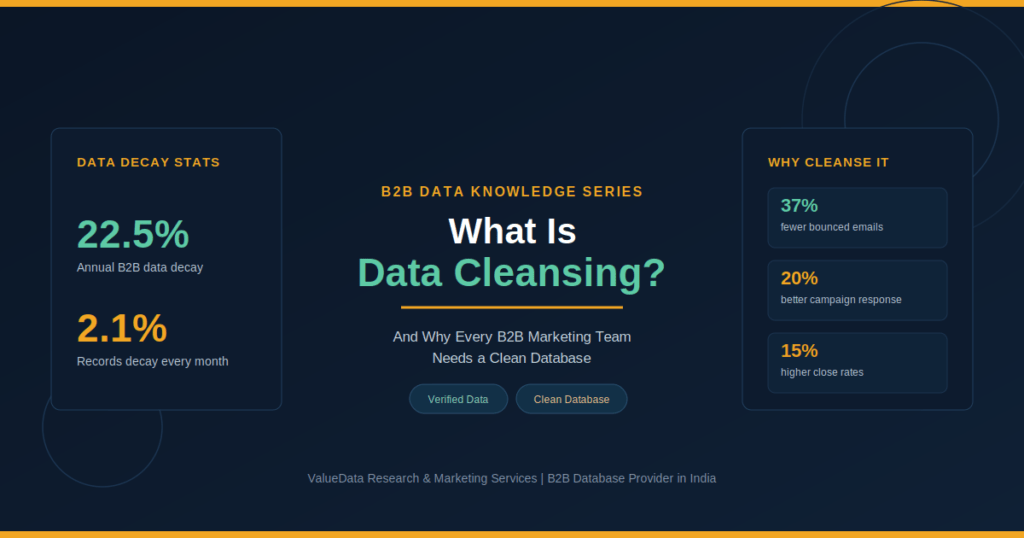
Industry research (commonly cited from Marketing Sherpa and referenced by HubSpot and Cognism) puts B2B contact data decay at roughly 2.1% per month, compounding to about 22.5% per year. In practical terms: if you have 10,000 contacts today, roughly 2,250 of them will contain outdated or inaccurate information within twelve months — without a single manual data-entry error.
Why does this happen so fast?
Left unmanaged, this decay compounds. Poor data quality is estimated to cost businesses trillions of dollars annually in wasted marketing spend, lost sales opportunities, and inefficient operations — and individual organizations often lose the equivalent of several million dollars a year in unrealized revenue tied directly to bad data.
Sending campaigns to a list full of invalid or dead email addresses drives up your bounce rate. Email providers like Gmail and Outlook actively penalize senders with high bounce rates by routing future emails straight to spam — even the ones going to genuinely interested prospects. Regular list cleansing keeps your bounce rate low and your domain reputation healthy.
Clean, accurate data means your sales team is calling and emailing real decision-makers at real companies — not someone who left eight months ago. This directly improves response rates, meeting-booked rates, and ultimately closed deals — clean data drives 20% better campaign response rates and 15% higher close rates within six months.
Reps waste hours chasing dead leads, correcting records manually, or re-verifying information that should already be accurate. A clean database means your team spends time selling, not fixing spreadsheets.
Nothing damages a prospect’s impression of your brand faster than three different reps calling them about the same offer because of duplicate records. Cleansing removes duplicates before they cause embarrassment.
Personalized, segmented campaigns rely on accurate firmographic data — industry, company size, job title, location. If that data is wrong, your “personalized” campaign is really just a well-formatted mistake.
Dirty data skews your analytics — false positives in lead scoring, inflated total addressable market numbers, and inaccurate ROI reporting on campaigns. Clean data means your reports actually reflect reality.
A proper B2B data cleansing workflow typically covers:
| Step | What Happens |
| Deduplication | Identifying and merging duplicate contact and company records |
| Email verification | Checking each email address for validity and deliverability |
| Phone number validation | Confirming numbers are active and correctly formatted |
| Standardization | Making formats consistent (company names, job titles, addresses) |
| Enrichment | Filling in missing fields with verified, up-to-date information |
| Suppression | Removing unsubscribed, bounced, or opted-out contacts |
| Ongoing monitoring | Re-checking records on a scheduled basis, not just once |
Given that decay compounds every month, most B2B teams should treat cleansing as a recurring cycle rather than an annual event:
Waiting a full year between cleanups allows decay to compound to the point where a large share of the database needs to be re-verified or replaced entirely.
At ValueData, our data cleansing services combine automated verification with human research to make sure your database stays usable, not just “technically updated.” Our process includes:
Combined with our verified B2B database of 20 million+ Indian contacts and 36 million+ global contacts, our data cleansing service ensures the data your team relies on is both large in scale and accurate in practice.
Data cleansing often gets treated as background IT hygiene — something to get to eventually. But given that B2B data decays by roughly a fifth every year, treating it as a one-time task guarantees your database gets worse, not better, with time.
Clean data isn’t just about tidiness. It directly affects your deliverability, your lead quality, your team’s efficiency, and ultimately your revenue. Whether you’re running a small outbound team or managing a database of hundreds of thousands of contacts, a regular cleansing cadence is one of the highest-leverage things you can do for your marketing and sales performance.
Ready to clean up your database? Contact ValueData today for a free data health assessment. Email: enquiry@valuedata.in | Call: +91 70214 90895


Leave a Comment