
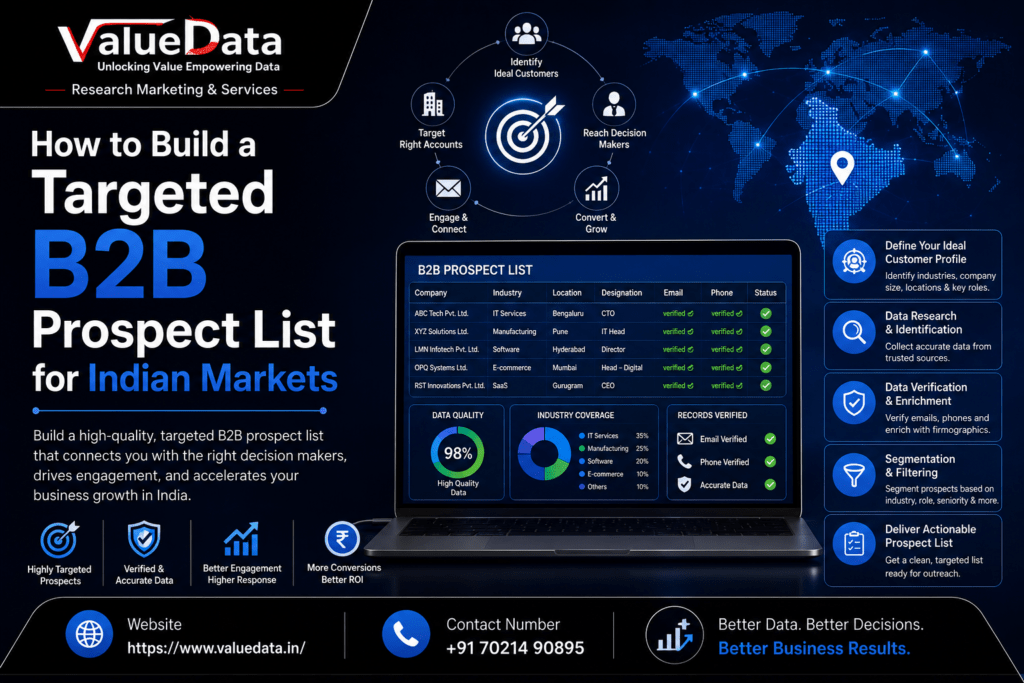
A targeted B2B prospect list is the starting point of every successful sales campaign in India. Without it, even the best pitch falls flat, because you are simply talking to the wrong people. So, if your outreach numbers look weak lately, the real issue may not be your message. It may be your list.
In this guide, we will show you exactly how to build a targeted B2B prospect list for Indian markets, step by step. We will also cover the unique challenges of prospecting in India, and how to avoid the common mistakes that waste time and budget.
A targeted B2B prospect list is a curated set of companies and contacts that closely match your ideal customer profile. Unlike a generic list, it is not built for volume. Instead, it is built for relevance.
A strong B2B prospect list typically includes:
In short, a targeted B2B prospect list gives your sales team a shortlist of accounts worth pursuing, instead of a random pile of contacts to sort through.
India is one of the fastest-growing B2B markets in the world. However, that growth also makes prospecting harder, not easier. There are more companies to track, more regions to cover, and more communication styles to navigate.
For example, Indian business contacts often rely on mobile-first communication. So, an accurate phone number frequently matters more than a generic email address. Additionally, India’s B2B landscape stretches far beyond Bangalore, Hyderabad, and Pune. Many high-potential companies operate out of Tier-2 and Tier-3 cities, where global databases often have thin or outdated coverage.
Because of this gap, generic international data providers frequently miss Indian mid-market companies altogether. As a result, building a targeted B2B prospect list for India requires local research, not just a bulk export from a global tool.
Before you build a B2B prospect list, you need clarity on who you are actually targeting. Otherwise, you risk collecting contacts that look good on paper but never convert.
Start by answering these questions:
Once you have clear answers, your B2B prospect list becomes far easier to build. And more importantly, it becomes far easier to convert.
Not all data sources are equal, especially in India. Therefore, choosing the right source is one of the most important steps in this entire process.
Company registries. India’s Ministry of Corporate Affairs (MCA) database offers verified company information. This ground-truth data is far more reliable than scraped websites, since it reflects legal registration records.
LinkedIn. LinkedIn works well for urban, tech-forward companies. However, it becomes less reliable for regional manufacturing firms or traditional SMEs, where decision-makers are often not active on the platform.
Verified B2B databases. A research-backed B2B database combines multiple sources and manually verifies each contact. This approach is especially valuable for Indian markets, where mobile number accuracy and regional coverage make or break your outreach results.
For further context on how Indian data challenges differ from global markets, you can read this breakdown on sourcing accurate B2B data for Indian decision-makers.
A B2B prospect list is only as good as its accuracy. Even a well-researched list decays over time, since people change jobs and companies restructure constantly.
So, before you launch outreach, verify the following:
If your existing list has grown messy over time, a structured data cleansing process can remove duplicates and correct outdated fields before you invest more time in outreach.
India is not one single market. It is many markets layered together. Therefore, segmenting your B2B prospect list is essential for relevant messaging.
For instance, a manufacturing company in Ahmedabad has different priorities than a SaaS company in Bangalore. Similarly, a company in a Tier-2 city may respond better to phone outreach, while a metro-based tech company may prefer email or LinkedIn first.
So, break your list into smaller segments based on:
As a result, your messaging becomes sharper, and your B2B prospect list becomes far more effective at driving replies.
Not every contact in your B2B prospect list deserves the same level of attention. Some companies are simply more ready to buy than others, right now.
Buying signals worth tracking include:
When you prioritize your B2B prospect list using these signals, your sales team spends time on accounts that are actually ready to engage. Consequently, your conversion rate improves, without increasing your outreach volume.
Building a targeted B2B prospect list is not a one-time project. Since Indian companies grow, merge, and restructure quickly, your list needs regular maintenance.
Without ongoing updates, your B2B prospect list slowly becomes outdated. Emails start bouncing. Job titles become inaccurate. And your sales team wastes valuable time chasing contacts who have already moved on.
To avoid this, set a refresh schedule, ideally quarterly, and pair it with a master database management approach. This gives you a single, centralized view of every contact, which makes ongoing accuracy far easier to maintain.
Building a targeted B2B prospect list is only half the job. The other half is using it well. Even the most accurate list underperforms if your outreach approach ignores how Indian buyers actually prefer to engage.
Start with a multi-channel approach. Relying on a single channel, such as email alone, tends to underperform in India. Instead, combine email, phone calls, and LinkedIn outreach for the same account. This way, you reach decision-makers through the channel they actually respond to, rather than guessing.
Next, personalize your first message using real details from your B2B prospect list. Reference the company’s industry, recent growth, or a specific pain point relevant to their sector. Generic templates get ignored quickly, especially by buyers who receive dozens of cold messages every week.
Also, time your outreach around buying signals. If a prospect just raised funding, expanded to a new city, or hired for a relevant role, that is the moment to reach out, not three months later. Contacting the right person at the right time can be the difference between a reply and silence.
Finally, track response patterns across your B2B prospect list. If a certain region, industry, or job title consistently responds better, feed that insight back into how you build and prioritize future lists. Over time, this creates a feedback loop that keeps improving your targeting.
Not every company on your B2B prospect list should be approached the same way. Company size changes everything, from who makes the decision to how long the sales cycle takes.
Startups and small businesses often have shorter sales cycles and fewer decision-makers involved. A single founder or department head may be able to approve a purchase directly. So, your B2B prospect list for this segment should prioritize speed and simple, direct messaging.
Mid-market companies usually involve two or three stakeholders in a buying decision. Your outreach should address both the practical user of your product and the budget owner, since both need convincing before a deal closes.
Enterprise companies involve larger buying committees, often stretching across procurement, IT, and department leadership. Building a B2B prospect list for enterprise accounts means mapping multiple contacts within the same company, not just one decision-maker.
Because of these differences, segmenting your B2B prospect list by company size helps your sales team set realistic expectations and tailor their approach accordingly.
Even experienced teams make mistakes when building a B2B prospect list. Here are the most common ones to avoid.
Relying only on LinkedIn. This works for metro tech companies, but it misses a large share of India’s regional business landscape.
Ignoring mobile numbers. Email-only outreach underperforms in India, where many decision-makers prefer calls or WhatsApp for initial conversations.
Skipping verification. An unverified B2B prospect list looks impressive in size, but it wastes budget through high bounce rates and dead contacts.
Treating India as one market. Messaging that works in Mumbai may not land the same way in a Tier-2 manufacturing hub. Segmentation matters.
No refresh cycle. A list built once and never updated becomes less useful every single month.
At ValueData, we specialize in building targeted B2B prospect lists designed specifically for Indian markets. Our research team combines verified company data with manual checks, so you get a list built for real conversions, not just contact volume.
Here is what that looks like in practice:
If your team is ready to stop wasting time on the wrong contacts, get in touch with ValueData for a free sample database built for your target market.
How big should a B2B prospect list be to start with?
Quality matters more than size. A focused list of 200 to 500 highly relevant contacts often outperforms a generic list of thousands.
How often should a B2B prospect list be refreshed?
Quarterly refreshes work well for most industries. Fast-moving sectors like technology and startups may need monthly checks.
Is LinkedIn enough to build a B2B prospect list in India?
Not on its own. LinkedIn works well for urban, tech-forward companies, but it misses many regional and traditional businesses. Combining it with verified data sources gives better coverage.
Should I prioritize email or mobile numbers for Indian prospects?
Both matter, but mobile numbers often carry more weight in India, since many decision-makers prefer calls or WhatsApp for early conversations.
At the end of the day, a targeted B2B prospect list is not just a spreadsheet. It is the foundation of every sales conversation, every campaign, and every closed deal. Building one for Indian markets takes extra care, since the country’s regional diversity, mobile-first habits, and fast-moving business landscape do not respond well to generic, one-size-fits-all data.
So, if your pipeline has felt inconsistent lately, start with your list. Because once your B2B prospect list is accurate, relevant, and well-segmented, every step after it, from first outreach to closed deal, becomes easier.


Leave a Comment