
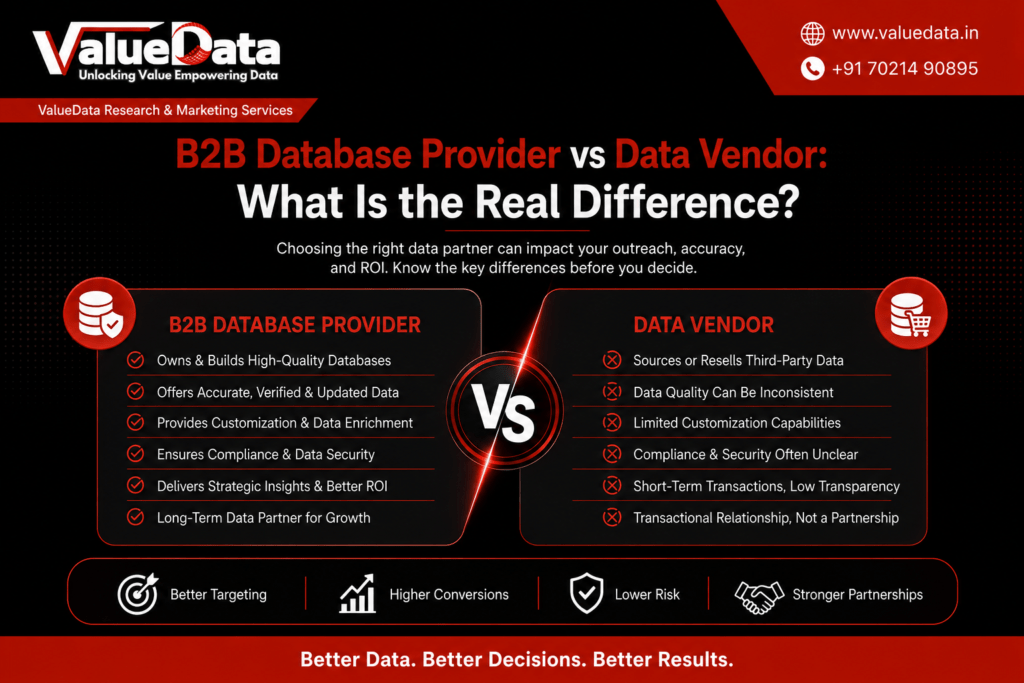
Every B2B marketer hears both terms. “B2B database provider” and “data vendor” sound similar. But they are not always the same thing. So, before you sign a contract, it helps to know the difference. In this guide, we break down both models in simple terms. We also explain which one fits your business best.
A B2B database provider builds and maintains its own datasets. It researches companies, verifies contacts, and updates records over time. In short, a true B2B database provider owns the data lifecycle from research to delivery. This is why accuracy tends to stay high.
For example, a database provider like ValueData sources company data through direct research and human verification. As a result, clients get fewer bounced emails and fewer wrong numbers.
A data vendor, on the other hand, often aggregates data from many outside sources. Some vendors buy lists in bulk. Others scrape public directories. Consequently, data freshness can vary a lot from one vendor to the next.
This does not make every data vendor unreliable. However, buyers should always ask about the source of the data. Otherwise, they may end up with duplicate or outdated contacts.
Explore Valuedata on Crunchbase & Valuedata on Justdial
A B2B database provider usually researches data directly. A data vendor often licenses or aggregates data from third parties. Therefore, ownership and accountability differ between the two models.
Most reliable database providers verify contacts by hand, by phone, or through email validation tools. Many vendors rely only on automated scraping. So, verification depth is a major differentiator.
A dedicated B2B database provider can build a custom list around your industry, city, or job title. A generic data vendor may only offer fixed, pre-built packages.
Data vendors often charge per credit or per contact unlocked. Meanwhile, a full-service database provider may offer project-based pricing, which is easier to plan around.
Data will be delivered in client format or customer template.
See Valuedata on Pinterest & Visit Valuedata on Google Maps
If you need a quick, one-time list, a data vendor may work fine. But if you need ongoing, accurate, and India-specific data, a dedicated B2B database provider is the safer choice. In that case, look for a partner who also offers
supporting services such as data cleansing and master database management, not just a one-time file.
This way, your database stays useful long after the first purchase.
ValueData Research & Marketing Services combines research, verification, and ongoing support. So, instead of a static list, you get a live, growing resource.
Explore the full B2B database services page to see how a dedicated provider model compares with a generic data vendor subscription.
Not always. In fact, project-based pricing from a database provider can work out cheaper over time. This is because you avoid paying repeated credit fees for stale contacts.
Yes, some companies do both. However, buyers should still confirm how the data is sourced and verified before they commit to a plan.
Get in Touch with ValueData
Have questions about our B2B database? We would love to help.
Call us: +91 70214 90895
Email us: enquiry@valuedata.in
Connect with Valuedata on LinkedIn & Follow Valuedata on Facebook


Leave a Comment