
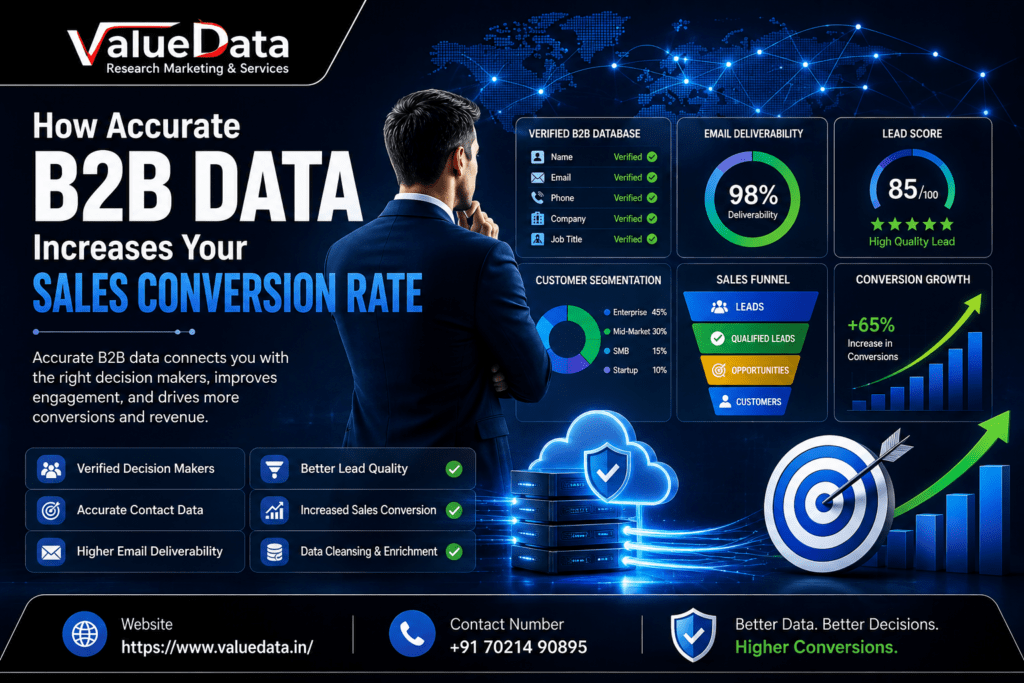
Accurate B2B data is the single biggest factor separating sales teams that hit their targets from teams that miss them. In fact, accurate B2B data directly decides whether your outreach lands in front of a real decision-maker or disappears into a bounced inbox. So, if your conversion rate has been stuck for months, the problem may not be your pitch. It may be your data.
In this guide, we will break down exactly how accurate B2B data increases your sales conversion rate. We will also show you the warning signs of bad data, and how to fix it before it costs you more revenue.
Accurate B2B data means contact and company information that is current, verified, and complete. This includes:
In short, accurate B2B data reflects reality right now, not reality from two years ago. As a result, when your data is accurate, every message you send reaches a real person who can actually make a buying decision.
Let’s connect the dots. Your conversion rate depends on three things: reaching the right person, at the right company, with a relevant message. Accurate B2B data supports all three.
First, accurate B2B data ensures your emails and calls reach real, working contacts. Therefore, fewer messages bounce, and more prospects actually see your offer.
Second, accurate B2B data means your messaging matches the person’s current role. So, instead of pitching a “Marketing Manager” who was promoted to “VP” six months ago, you speak directly to their real priorities.
Third, accurate B2B data protects your sender reputation. Consequently, your emails land in the inbox instead of spam, which keeps your entire outreach engine working.
Put simply, clean data removes the friction between your pitch and your prospect. And less friction means more conversions.
Bad data is expensive, and the numbers prove it. According to research from CIENCE, B2B data decays at an average rate of 2.1% per month, which adds up to roughly 25% of a database becoming inaccurate within a single year. That means a full quarter of your contact list could already be outdated without you knowing it.
The damage does not stop there. Gartner research estimates that poor data quality costs organizations an average of $12.9 million every year, once you factor in wasted outreach, missed opportunities, and lost productivity. Meanwhile, sales representatives can lose hundreds of hours annually simply validating and correcting bad contact information instead of selling.
For further detail on how data decay affects B2B sales performance, you can read the full breakdown from CIENCE’s research on data decay in B2B sales.
To put that in perspective, a sales rep who loses even a few hours a week fixing bad contact details is losing nearly a full day of selling time. Multiply that across a full team, and the cost becomes significant, fast. And because bad data rarely announces itself, most teams do not notice the drain until pipeline numbers fall short of target.
Now, imagine that same wasted time and budget redirected toward real conversations with real buyers. That is the opportunity accurate B2B data unlocks.
Many teams still believe that a bigger contact list automatically means better results. However, this is one of the most common myths in B2B marketing. A list of 100,000 unverified contacts will almost always underperform a list of 10,000 verified, accurate contacts.
Here is why. First, unverified data leads to high bounce rates, which damages your sender reputation. Second, generic bulk lists rarely match your ideal customer profile, so you end up messaging people who were never going to buy in the first place. Third, your sales team wastes valuable time sorting through irrelevant leads instead of engaging real prospects.
In contrast, accurate B2B data prioritizes relevance over volume. As a result, every contact you reach is someone worth reaching, which naturally lifts your response and conversion rates. So, before you buy your next database, ask yourself: do you need more contacts, or do you need better ones?
It is not just your sales team that suffers from inaccurate B2B data. Your marketing budget takes a hit too.
Consider a paid LinkedIn or Google Ads campaign built on outdated firmographic data. If your targeting criteria rely on old company sizes, incorrect industries, or stale job titles, your ads reach the wrong audience. Consequently, your cost-per-lead rises, while your actual lead quality drops.
The same applies to account-based marketing. ABM campaigns depend heavily on precise firmographic and contact data to personalize outreach at the account level. So, when that underlying data is wrong, your carefully built ABM sequence loses its edge, and your investment in personalization goes to waste. In short, accurate B2B data is not only a sales issue. It is a marketing efficiency issue too, one that touches every channel where you spend budget to reach decision-makers
Accurate B2B data does not just help one part of your sales process. Instead, it strengthens every single stage, from first contact to closed deal.
Accurate B2B data helps you build target lists that actually match your ideal customer profile. As a result, your sales team spends less time researching and more time selling. A strong B2B database gives your team a reliable starting point, filtered by industry, company size, and role.
When your data is accurate, fewer emails bounce. Consequently, your domain reputation stays healthy, and future campaigns keep reaching the inbox instead of the spam folder. This is especially important for teams running high-volume email database and marketing campaigns, where one bad send can hurt deliverability for weeks.
Accurate firmographic and contact data means your lead scoring model actually works. Otherwise, your team wastes time chasing “hot” leads that are, in reality, outdated or irrelevant records.
Personalization only works when the underlying data is correct. For example, referencing someone’s old job title instantly signals that your outreach is generic, not researched. On the other hand, accurate data lets you personalize with confidence, which builds trust faster.
Accurate B2B data reduces back-and-forth caused by wrong contacts or outdated information. Therefore, deals move faster through the pipeline, since your team is not stuck chasing the wrong person at the wrong company.
Not sure if your data is holding you back? Here are five warning signs to watch for:
If two or more of this sound familiar, it is time for a data cleansing pass. A structured data cleansing process can remove duplicates, correct outdated fields, and restore trust in your CRM.
So, how do you actually get to accurate B2B data? Here is a simple, practical approach.
First, audit your existing database. Identify duplicates, missing fields, and clearly outdated records. This gives you a baseline to work from.
Next, invest in verified data sources. Rather than scraping contacts from random websites, work with a provider that manually verifies emails, phone numbers, and job titles. This is where dedicated data research services make a real difference, since human verification catches errors that automated tools often miss.
Then, set a regular refresh cycle. Because data decays every month, a one-time cleanup is not enough. Instead, build a quarterly or monthly refresh process into your operations.
Finally, centralize your data. Scattered spreadsheets and disconnected CRM fields make errors more likely. A master database management approach gives your team a single, 360° view of every contact, which makes ongoing accuracy far easier to maintain.
At ValueData, accurate B2B data is not an afterthought. It is the foundation of everything we do. Our research team manually verifies contacts, so you get a database built for real conversions, not just contact volume.
Here is what that looks like in practice:
If your team is ready to stop wasting budget on bad contacts, get in touch with ValueData for a free sample database, and see the difference accurate data makes firsthand.
For businesses operating in India, accurate B2B data is not only a performance issue. It is increasingly a compliance issue too. With the DPDP Act 2023 now shaping how companies collect, store, and use personal data, working with unverified or scraped contact lists carries real regulatory risk.
Accurate B2B data providers typically source and verify information through transparent, research-backed methods, rather than mass scraping. As a result, working with a compliant provider protects your business on two fronts. First, it improves your conversion rate through better targeting. Second, it reduces your exposure to compliance issues tied to how contact data was originally collected.
So, when you are evaluating a data partner, do not just ask about pricing and volume. Ask about their verification process and data sourcing methods too. That is where the real long-term value, and the real long-term risk, lives.
How often should B2B data be refreshed?
Since data decays at roughly 2% per month, most teams benefit from a quarterly refresh at minimum. High-growth industries like SaaS and technology change even faster, so monthly checks are often safer.
What is a good accuracy rate for a B2B database?
Top-tier providers deliver verified accuracy rates of 90% or higher. If your current provider cannot share an accuracy benchmark, that itself is a warning sign.
Can accurate B2B data really improve conversion rates, or is it just about deliverability?
Both. Accurate B2B data improves deliverability, but it also improves targeting and personalization, which are the two factors that most directly affect whether a prospect actually responds and converts.
Is it better to clean existing data or buy a new database?
It depends on your current data quality. If your CRM has a strong foundation with only some outdated fields, a data cleansing pass is often more cost-effective. If your data is largely outdated or was never verified, a fresh, research-backed database may be the faster path to results.
At the end of the day, accurate B2B data is not just a nice-to-have. It is the foundation of every successful sales conversion. Clean, verified data means fewer bounced emails, faster sales cycles, and sharper personalization. Meanwhile, inaccurate data quietly drains your budget and your team’s time, often without anyone noticing until pipeline numbers fall short.
So, if your conversion rate has plateaued, start with your data. Because once you fix the foundation, everything built on top of it, from outreach to closed deals, gets stronger too.


Leave a Comment